

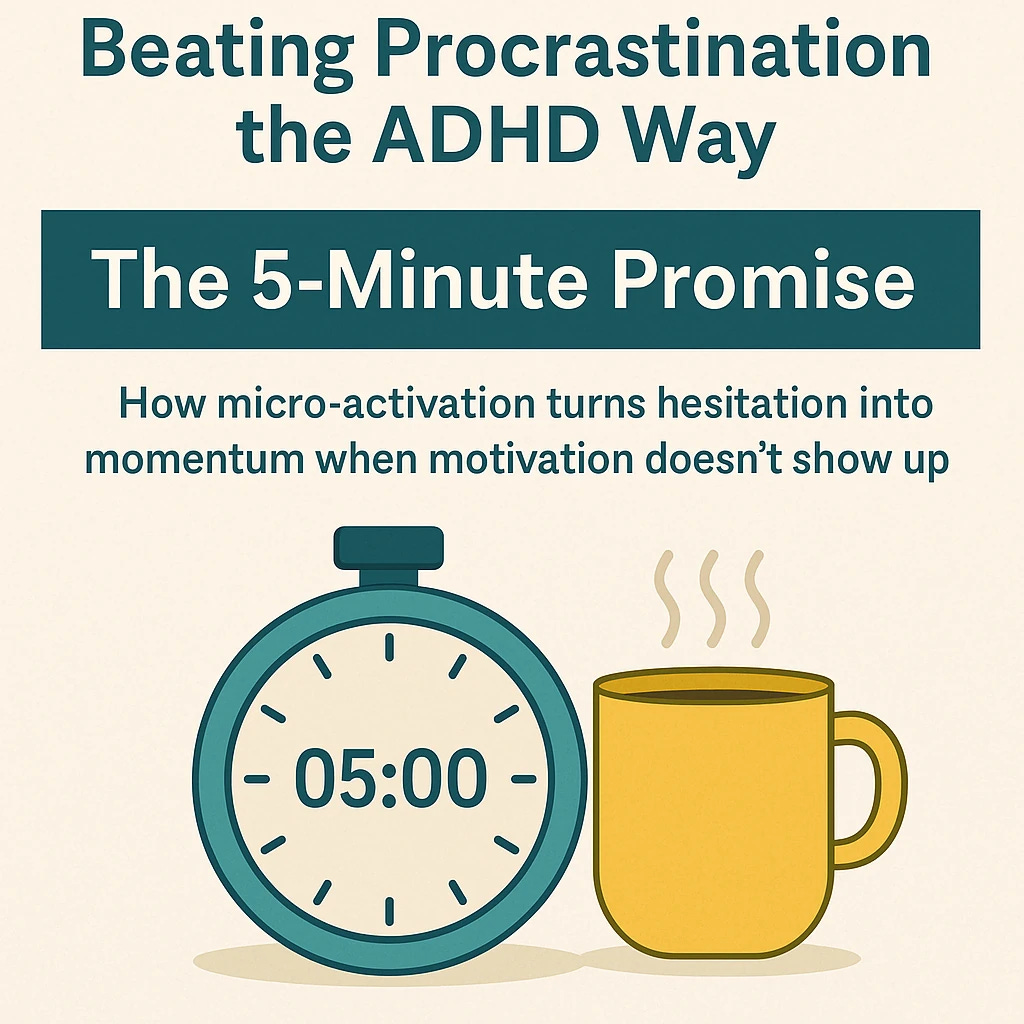
Beating Procrastination the ADHD Way - The 5 Minute Promise
Five minutes of action can do what hours of pressure can’t: unlock motion.

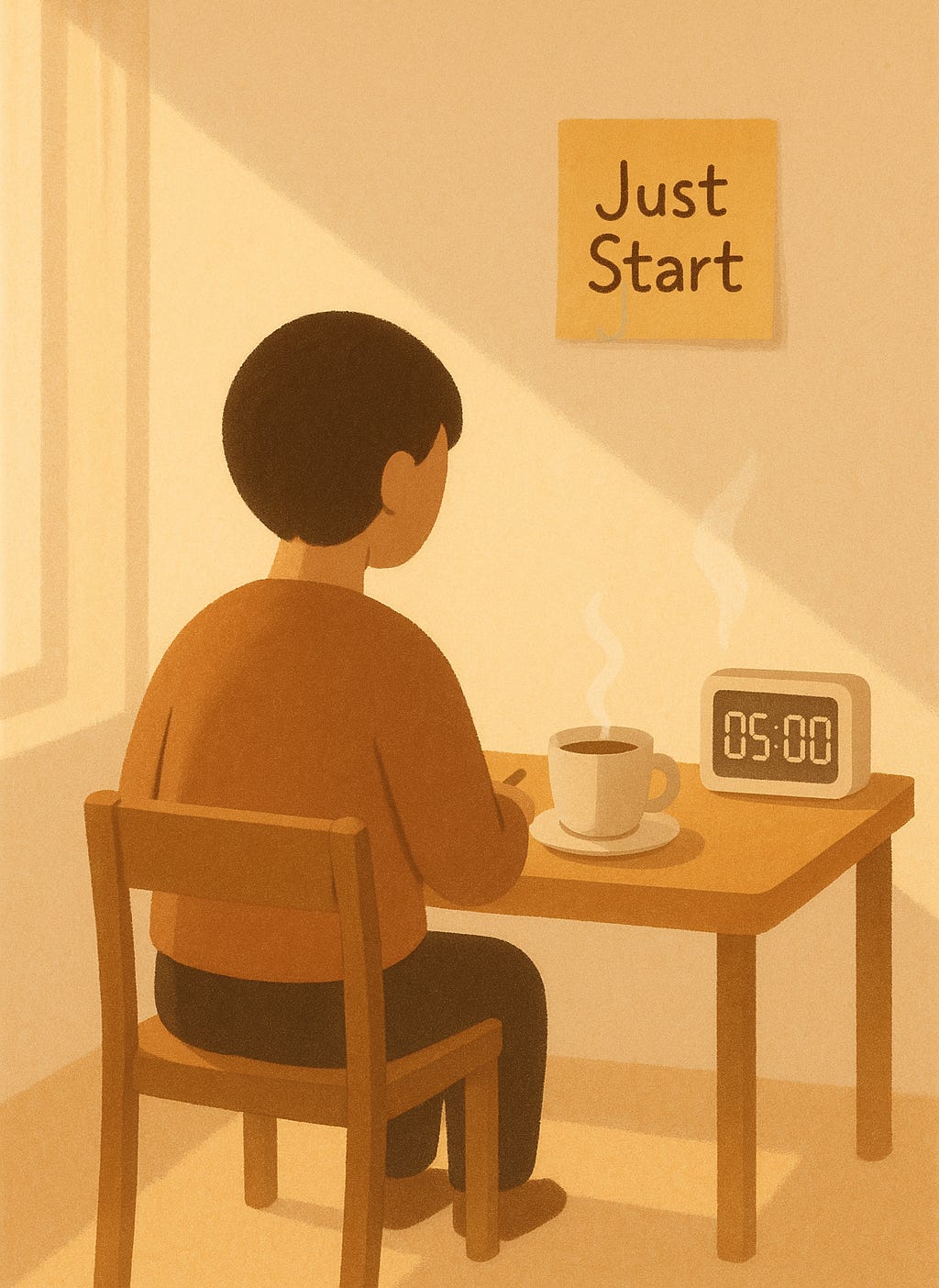
For most of us with ADHD, the hardest part of any task isn’t the doing — it’s the starting.
That moment between knowing what to do and actually beginning can feel like standing at the base of a mountain in flip-flops.
It’s not laziness or lack of willpower.
It’s chemistry.
Why Starting Feels Harder
In ADHD, the challenge isn’t that the brain lacks dopamine altogether, it’s that the dopamine signaling system is less responsive to anticipated rewards.
Where a neurotypical brain gets a small motivational spark from imagining completion (“this will feel good when it’s done”), an ADHD brain often doesn’t register that same spark strongly enough to activate.
That’s because the receptors and circuits that translate motivation into action — particularly in the prefrontal cortex and striatum — need a stronger or more immediate cue to respond.
In other words, the signal isn’t absent; it’s underpowered until something tangible begins to happen.
This makes it easy to get stuck in the pre-action phase - knowing exactly what to do but feeling no internal pull to begin.
The Power of Micro-Activation
This is where the 5-Minute Promise comes in.
By committing to just five minutes of engagement, you bypass the brain’s faulty reward forecast and move straight to the part that actually works - the doing.
Once movement or engagement begins, sensory and motor regions start firing, feeding live feedback into the reward network.
The act of doing — not the thought of doing — supplies the stimulation that reawakens focus and interest.
In behavioral science terms, this is called activation before motivation. By starting first, you give your brain a chance to update its reward prediction in real time.
Why Five Minutes Works
Five minutes feels achievable; it doesn’t trigger the perfectionism, fear of failure, or overwhelm that big goals can.
And yet those five minutes are enough to bridge the motivational gap — to convert intention into motion.
Once the system registers progress, even modestly, the sense of reward begins to amplify.
The outcome isn’t guaranteed productivity; it’s something subtler and more powerful -
a shift from mental resistance to physiological cooperation.
In Plain Terms
The ADHD brain doesn’t fail because it “runs out of dopamine.”
It struggles because the reward system needs proof of progress before it wakes up.
The 5-Minute Promise is how you provide that proof — not by thinking harder, but by starting smaller.
So today, skip the pep talk and give yourself a soft start.
You don’t have to climb the mountain.
Just take five minutes and see where your feet go.
Postscript!
If you’ve worked with me, or read enough of my musings, you’d realise that I am not a “Dopamine” evangelist by any stretch of the imagination. Dopamine plays its role, but the fashionable take often misrepresents how Dopamine actually functions.
Read further if you want to appreciate how it works within this particular context:
The Real Story: Dopamine Is About Signaling, Not Supply
When we talk about ADHD and dopamine, it’s not that people “don’t have enough dopamine” floating around - your brain doesn’t “run out of it”.
Rather, the issue lies in how dopamine is transmitted and received within certain neural circuits, particularly in the prefrontal cortex and striatal pathways (which handle motivation, attention, and reward evaluation).
Think of it like this:
The dopamine molecules (the “signal”) are present.
But the receptors that should respond to that signal — mainly D2 and D4 receptor types — are either less sensitive or less efficiently activated.
This means that the same amount of dopamine produces a weaker motivational response.
When a task doesn’t feel interesting, it’s not that your brain is intentionally “withholding” dopamine; it’s that the dopaminergic feedback loop between anticipating reward and feeling reward doesn’t light up as strongly as it does for neurotypical brains.
The brain learns: “This isn’t worth the energy.”
What Happens Instead
Because the receptor response is blunted, interest and urgency become the main ways ADHD brains compensate:
When something is novel, urgent, or personally meaningful, the dopaminergic signal spikes enough to overcome that lower receptivity.
When something is neutral or routine, the signal feels flat — even if the logical brain knows it’s important.
So, rather than a dopamine shortage, ADHD involves a different reward calibration system — one that requires stronger or more immediate cues to feel motivated.
Why the “5-Minute Promise” Still Works
When you start doing (even for five minutes), your motor and sensory systems activate - and those regions are richly connected to dopamine pathways.
That physical initiation provides bottom-up stimulation that helps bridge the weak top-down motivational signal.
In simpler terms:
If thinking about starting doesn’t trigger enough reward signaling, starting anyway helps generate it through movement and engagement.
That’s why behavioral activation — even micro-activation — works so well for ADHD.
A Better Framing
Instead of saying “the brain withholds dopamine,” it’s more accurate to say:
“The ADHD brain has a muted response to expected reward, making it harder to feel motivated until engagement begins.”
It’s a receptivity issue, not a deficiency issue, and once you grasp that, strategies like “The 5-Minute Promise” make perfect sense - they create the conditions for dopamine signaling to catch up to your intentions.
As always, tuned in to your thinking - thank you, Shane. A modification (or variation on the concept) for my part:
.a) - “just five minutes” is a variant on multiple forms of constrained objective-framing (which is how I’m terming the “just five minutes” concept)
.b) - like all of us (lovely inclusive broad generalisation there ☺️) who have ADHD-affected behaviour, all of us have our own unique cues
.c) - “just five minutes” - literally, will kill me. A ‘time’ based constraint is a f’k up of epic proportions for me
.d) - a physical, tangible goal is my distinctly more functional framework
.e) - okay, okay, when it comes to doing a little bit of blood-circulation energy and body work (aka the dreaded “exercise”), then ‘just five minutes’ does work a charm - I’ll give that one
.f) - as above, alternative naming works a treat - i.e. it’s not “doing my work”, it’s “writing a paragraph in the report”, it’s not “getting stuck on a model”, it’s jumping the hoop and opening up the model, it’s not “getting stuck on a model”, it’s jumping through the hoop and asking for help, it’s not “getting hamstrung by I.T.”, it’s ‘try again today to solve the problem - i.e. communicate with I.T.’. L
.g.) - as already indicated above, the tangible alternative to “just five minutes”, is also to do with how long and what I’ll be doing before I actually get started. In this scenario, you can spin tricks with “just five minutes” - it’ll be a doozy every time. But, if I look at the clock and say, okay, at 3.00pm then . . . .’I’ll stop playing games’, and limit it to that, then okay, provided that: (i.) 3.00pm is not an hour away, i.e. the time that I set as my limit is a time of day, not a duration, and (ii.) that time of day must be suitably close to the time that it is now for it to have meaning. .eg. If I’m lying on the couch vegging with cellphone games and it’s 1.00pm, and I set myself 3.00pm to stop playing games - . . . .bwahahahaha - it’s a myth. But if it’s 1.00pm and I set myself 1 hour to sink into it, and immerse, without further thought of what comes next, then I know fully confidently that when 2.00pm comes around, my mind will be ready for doing something next. Whatever that ‘next’ is.
.h.) - and here’s the special part, the “next” thing to do is where it gets meaningful. Whatever comes next has to be tolerable in order for it to actually happen. And this is where the personal modification of “just five minutes” is more aligned with what is my reality, i.e. sometimes it’s not a big thing - i.e. no thought given to it at all, i.e. I’ve had my 1hr couch-time, and it’s not even thought about getting back onto the desk.
.g.) - however, I think you get the concept : whatever it is that will tear me away into a constructive action, is exactly that - a bound activity : just one row of knitting, just one item of DIY or domestic chore (and then not some arbitrary scope - be specific, fix the plug, change the lightbulb, connect the garden hose, cook the veggies, take out the trash) . . . .literally just one. And if it turns out that literally just one is what you can manage, then hallef’kngluiah; seriously - halleluiah. Do it. Do that one thing. And if you need to go back to the couch for another reset then do that. If you have the internal stamina to do one thing else, then do that.
Pick that one thing. It may be tangible, it may be “just five minutes” (for me, “just five minutes” is simply insufficiently tangible, but the concept is on the nailhead). Pick one thing. Make it a small thing. The equivalent of one step; one walk around the block, . . . . .
My piece of thought. Thanks always, Shane ☺️